The short answer
In the UAE a child under four must ride in a child seat, and children aged ten or under, or shorter than 145 centimetres, may not sit in the front. Never hold a child on your lap. With drivoo, add one child seat per young child when you book; only a car that carries one is sent.
Why it matters on UAE roads
A family trip in the UAE often means long drives: an hour or more from the airport to a beach hotel, a day trip from Dubai to Abu Dhabi, or a weekend in the mountains of Ras Al Khaimah. Much of that time is spent on fast motorways. A child seat that fits your child, fitted properly, is the single most important thing you can do for their safety in the car, and in the UAE it is also the law for young children. This guide sets out what the rules say, which kind of seat suits which age, and how to make sure the car that collects you at the airport has a seat ready. It is general guidance, not legal advice, so check the current rules with the authorities before you travel.
What the rules say
The UAE traffic regulations, as the Roads and Transport Authority (RTA) and the police set them out, make two points that every family should know. First, children under four must travel in a child safety seat suited to them. Second, children aged ten or under, or shorter than 145 centimetres, may not sit in the front seat. The driver is responsible for making sure passengers are properly secured, and breaking these rules is a traffic offence with a fine. Abu Dhabi Police also advise that children keep using a car seat or booster until they are 145 centimetres tall, and only then use the car’s own seat belt. Traffic rules are updated from time to time, so check the RTA or your emirate’s police for the latest before you travel.
Which seat for which age
The RTA’s guide for drivers in Dubai describes the usual progression. Babies under one year and under 10 kilograms travel in a rear-facing seat, placed in the middle of the rear seat. Children between one and four use either a rear-facing seat or a forward-facing seat with a built-in harness, in the rear. Children from four to under seven use a forward-facing seat with a built-in harness. Older children, roughly six to eleven and up to 36 kilograms, use a booster seat, which lifts them so that the adult seat belt crosses the shoulder and the hips rather than the neck and the stomach. These age bands overlap, because children grow at different rates: the weight and height limits printed on the seat itself are what matter, so always follow the manufacturer’s instructions.
Never on a lap, and mind the airbag
However short the ride, don’t hold a child on your lap. In a sudden stop, an adult can’t hold on to a child, and the police in the UAE advise parents against it. Seat belts shared between an adult and a child are just as dangerous. A rear-facing baby seat must never be placed in front of an active airbag, which is one more reason the rear seat is the right place for young children. If your child is upset or unwell on a long drive, ask the driver to stop somewhere safe rather than taking them out of the seat while the car is moving.
Taxis, chauffeurs and your own seat
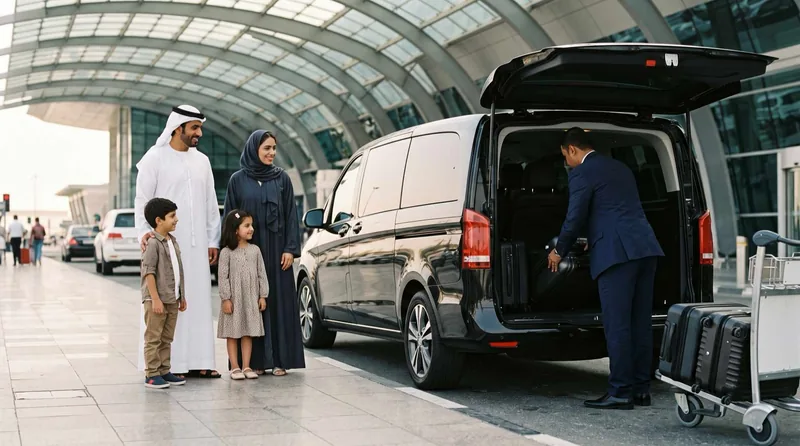
At a taxi rank you take the next car, so you can’t choose one with a seat for your child in advance; if you are relying on a taxi, check before you set off or bring your own. With a pre-booked chauffeur, you can plan it. When you book a drivoo ride, add a child seat: it is an extra, and the booking shows whether a car in your chosen class has one, and we confirm it before your ride. If no car in that class lists a seat right now, the booking tells you, so you can decide before you confirm. Add one seat for each young child, and use the note to the chauffeur to give the children’s ages. At the airport, Meet & Greet, which you can add when you book where it is offered, includes help with the baby seat as well as the bags. If you bring your own seat, count it among your bags so the car has room, and say so in the note.
Checking the seat before you set off
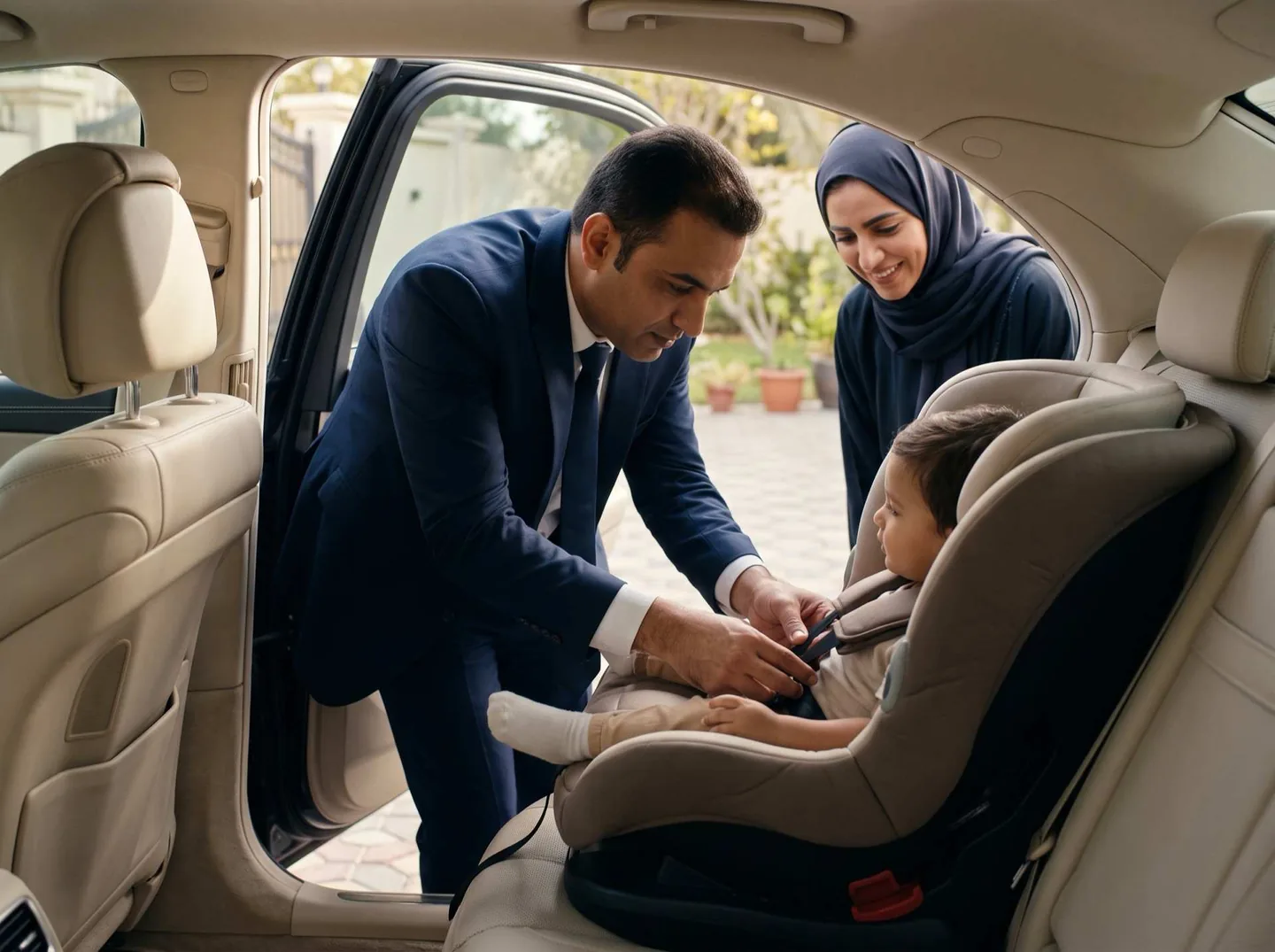
Whoever provides the seat, take a minute to check it before the car moves. The seat should be firmly fixed, moving no more than a little when you push it at the belt path. The harness should be snug, with the straps flat and not twisted, and the chest clip, if there is one, at armpit level. For a booster, the lap belt should sit low across the hips and the shoulder belt across the middle of the shoulder. If something doesn’t look right, ask the chauffeur to wait while you adjust it. A few minutes at the kerb matter more than arriving early.
Long drives between emirates
Children travel better when the trip is planned around them. For a long drive, such as Dubai to Abu Dhabi or out to the east coast, avoid the rush hours, and add a stop on the way if you need one: in the drivoo app you can add up to three stops when you book. For a family day out with several stops, a chauffeur by the hour in Dubai keeps the same car, with the seats fitted, all day, so you don’t refit a seat at every stop. A larger family with luggage and a stroller can choose drivoo Van when one fits. In the summer months, ask the chauffeur to cool the car before the children get in, because seats heat up quickly in the sun.
A checklist for families
Before you book, note each child’s age, weight and height, and decide whether each needs a rear-facing seat, a forward-facing seat with a harness or a booster. Add one child seat per young child when you book, enter every passenger and every bag, including the stroller, and use the note to give the children’s ages. Keep the youngest in the back, and never on a lap. If you are landing, add your flight number so the pickup follows your flight. Our guides to luggage sizes and car capacity and choosing a vehicle class help with the rest, and you can book an airport transfer with a child seat for any UAE airport.